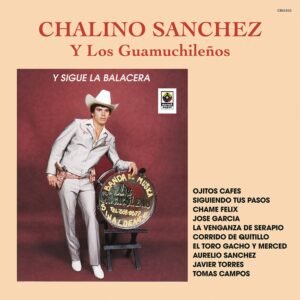
Craft Latino announces the first-ever vinyl release of Y sigue la balacera (The Gunfight Continues), a studio album from legendary Mexican singer-songwriter Chalino Sánchez, accompanied by Los Guamuchileños, arriving November 13. Originally recorded and released by Chalino in 1988 and later issued by Discos Musart in 1992, the album makes its long-awaited vinyl debut in a newly remastered edition, bringing one of the foundational recordings of Chalino’s catalog to collectors and a new generation of corrido fans. Featuring the raw storytelling and unmistakable sound that helped establish Chalino as El Rey del Corrido (The King of the Corrido), Y sigue la balacera captures the artist at a pivotal moment in the evolution of the modern corrido. The Sánchez family reflected on the return of this important early recording, “On behalf of the Sánchez family, we’d like to thank everyone involved in the re-release of this album. Especially the fans who year after year show their growing devotion to Chalino Sánchez and the music he left for us to enjoy. This was one of his earliest projects, one that was essential to his growth in the music industry, and we enjoy being able to present it again for the world to rediscover. As he would say, ‘Que siga la balacera.’”
Available for pre-order today, the reissue features a new remaster by Paul Blakemore from the original master tapes, with lacquers cut by Clint Holley and Dave Polster at Well Made Music. This vinyl debut offers collectors an opportunity to experience the album in a new physical format beyond its original cassette release and subsequent CD edition. A limited-edition “Bala de plata (Silver Bullet)” color vinyl variant, limited to just 300 copies, is available as a standalone LP or as part of a bundle featuring a collectible Chalino Sánchez T-shirt, exclusively online at Discosmusart.com. The album will also make its debut in Hi-Res Audio on November 13, with “Aurelio Sánchez Quintero” available today as an instant-grat single.
***
Y sigue la balacera captures a pivotal early chapter in Chalino Sánchez’s career, as he was developing the raw, deeply personal corrido style that would eventually make him one of the genre’s most influential figures. After beginning to write and record songs between 1985–87, Chalino operated entirely outside the traditional record industry, producing small runs of cassette tapes and personally selling and distributing them—often directly from the trunk of his car. By the time he recorded and released Y sigue la balacera in 1988, he had already issued approximately seven or eight independent cassette releases, including Más éxitos con Chalino Sánchez and Canta corridos al estilo Culiacán. Based in Los Angeles and building an audience through this grassroots approach, Chalino was rapidly gaining recognition, still without the backing of a record label, and laying the foundation for the remarkable career that followed.
The album brings together ten recordings backed by the legendary Sinaloan tambora band Los Guamuchileños, whose commanding brass sound amplifies Chalino’s distinctive storytelling and voice. Six of the corrido tracks were written by Chalino, with the collection largely devoted to vivid corridos drawn from tragic events, real-life characters, and tales of outlaw life in Sinaloa and beyond, alongside a couple of heartfelt love songs that open the set and offer a glimpse of his more romantic side.
“Aurelio Sánchez Quintero,” written by Federico Escamilla, is one of the most popular corridos on the album. The song immortalizes the story of “El Centenario,” a respected and formidable man from Valle de Topia, Durango, who was known for the large gold medallion he wore around his neck before being murdered in Mexico City. Another standout, hard-edged corrido is the Chalino-penned “Chame Félix,” a cautionary tale about a man who survives being shot by a friend wielding his own gun.
Two other corridos penned by Chalino on the album have since become genre classics. “La venganza de Serapio” is a revenge story centered on Serapio and the consequences of his actions, while “Corrido del Quitillo” is an action-packed outlaw tale about Andrés González Quiroz, known as “El Quitillo.” In the song, Quitillo is stopped at a fake checkpoint on a road in Sinaloa, where his captors demand money and jewelry before discovering that he is armed. A shootout ensues, and although Quitillo is wounded, he manages to escape.
Chalino was known to write corridos on commission, creating musical portraits of living figures whose stories and reputations could be preserved in song. “Javier Torres,” for example, does not recount a dramatic event, but instead pays tribute to Javier Torres Félix, a police commander from Chalino’s home region who was known for his reputation and bravery. Another character portrait is “José García,” about José García Quintero, who was a Sinaloan immigrant in California who “disappeared.” The song suggests, however, his name would live on in history through his son—a detail that may indicate that the song was commissioned by the family. The album closes with a somber portrait, “Tomás Campos,” a memorial corrido recounting the ambush and killing of Tomás Campos Salcido in Sinaloa and the mourning that followed among the community where he was known and loved as an honest and respected man.
More than 30 years after his death, Chalino Sánchez’s influence continues to grow. Widely regarded as the Godfather of the Corrido, he has inspired generations of artists across música mexicana and beyond. In recent years, his life and music have reached new audiences through the chart-topping podcast Ídolo: The Ballad of Chalino Sánchez and the VIX docuseries Nunca tuvo miedo, while the global rise of modern corridos has brought renewed attention to his groundbreaking work. Leading artists in the contemporary música mexicana movement, including Natanael Cano, Peso Pluma, Fuerza Regida, and others have cited Chalino as an important influence on the modern corrido sound. His reach extends well beyond the música mexicana community, with artists such as Snoop Dogg also acknowledging Chalino’s enduring influence and the broader cultural impact of his music.
Few recordings better capture the world Chalino was building in the earliest years of his career than Y sigue la balacera. First circulated through his own grassroots network and now making its vinyl debut more than three decades later, the album offers a direct connection to the sound, stories, and independent spirit that helped shape the modern evolution of the corrido. Its arrival on vinyl gives a new generation the opportunity to discover a foundational chapter of Chalino Sánchez’s legacy.